6 September 2026
Beyond the Dollar: China, Egypt and the Institutional Capital Behind a New Financial Architecture
"Moving away from the US dollar" ... Really?
overstates the scope of the deal between Egypt and China. What Egypt and China have built is a parallel settlement channel in renminbi and Egyptian pounds, which reduces dollar dependence at the margin without displacing it.
The swap line
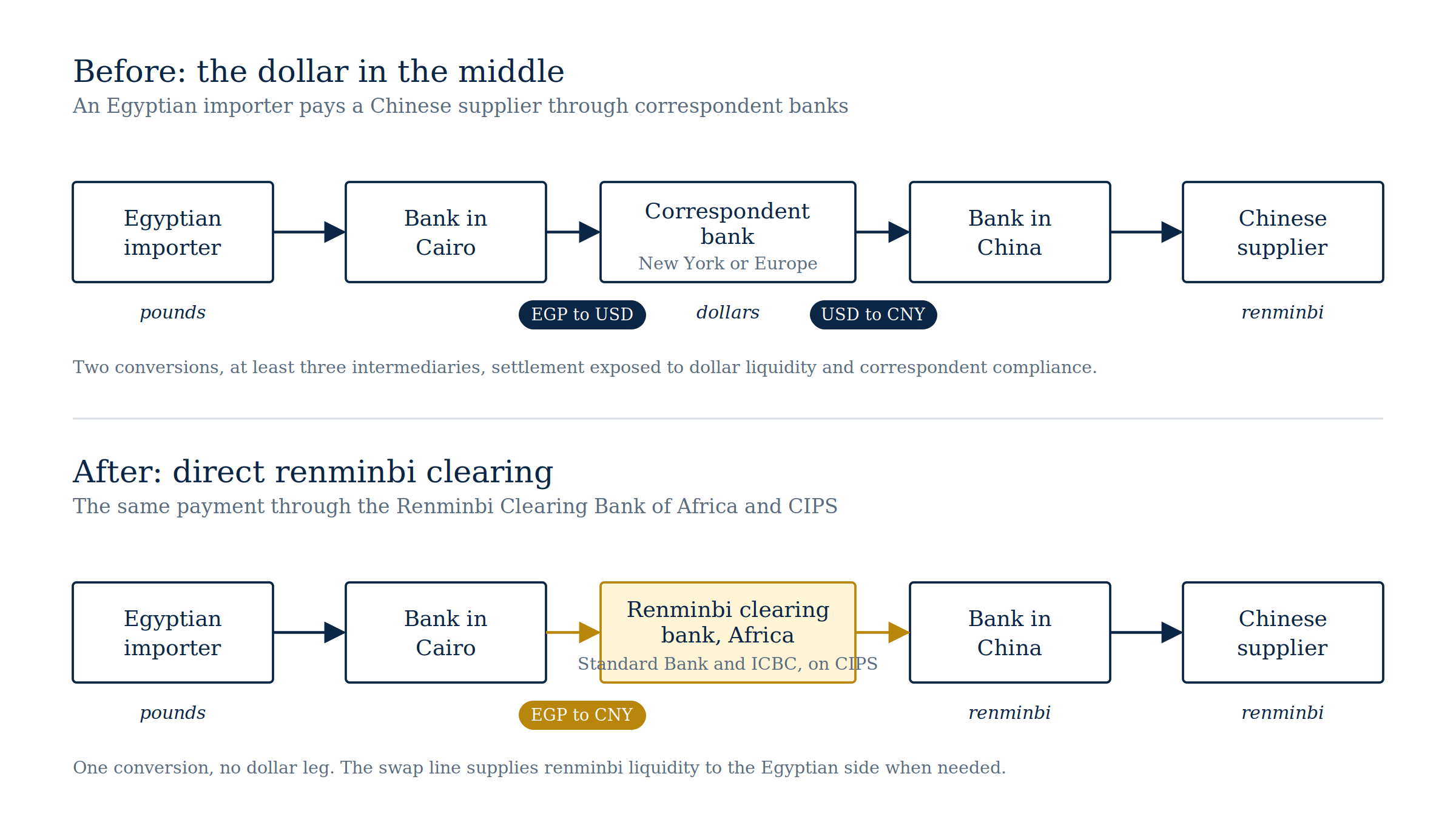
Start with the swap line. In June 2026, the People's Bank of China and the Central Bank of Egypt renewed their bilateral swap for three years and raised it from RMB 18 billion to RMB 30 billion, about US$4.4 billion. The September communiqué between the two presidents then endorsed the expanded facility and called for wider settlement of trade and investment in the two local currencies instead of routing every transaction through dollars. An Egyptian importer buying Chinese machinery has normally had to source dollars first, then pay the supplier in dollars. Under these arrangements, more of that business can be written directly in pounds and renminbi, and the intermediate demand for dollars falls.
None of this means Egypt is leaving the dollar. Egypt still needs dollars for external debt service, energy and commodity imports, reserves, international borrowing and trade with everyone other than China. This is diversification, not replacement. China itself remains deeply embedded in dollar finance, and its banks have been adding to their holdings of US Treasuries.
The plumbing
The clearing infrastructure may matter more than the swap. Standard Bank and ICBC were authorised in June to run the Renminbi Clearing Bank of Africa, covering RMB business in 19 African countries, and Standard Bank was already a participant in CIPS, China's cross-border payment system. This is plumbing. An African company paying a Chinese counterparty has typically had to move the payment through a chain of correspondent banks, usually in dollars, usually via New York or Europe. With direct renminbi clearing, there are fewer conversion steps, lower transaction costs, faster settlement and less exposure to dollar liquidity squeezes.
Why Egypt, why now
Egypt is worth this attention for reasons that go well beyond currency. It offers the Suez Canal, proximity to Europe, access to African and Middle Eastern markets, a large domestic economy and industrial zones ready to host Chinese manufacturing. The new communiqué is explicit about positioning Egypt as a hub linking Asia, Africa and Europe, with cooperation running across electric vehicles, shipbuilding, renewable energy equipment, data centres, cloud computing, semiconductors, critical minerals and manufacturing. Chinese investment in Egypt has already passed $10 billion. The currency arrangements sit underneath an industrial strategy.
There is an Egyptian logic, too. Egypt has repeatedly run short of hard currency. Every import that can be financed in renminbi is a dollar preserved for an obligation that genuinely requires one. Taking the dollar leg out of the middle of the transaction is the whole point.
Beijing gains more, and gains it strategically. It has spent years internationalising the renminbi one instrument at a time: swap lines, clearing banks, CIPS connections, panda bonds, and renminbi-denominated trade. The aim is not to displace the dollar next year. It is meant to ensure that enough countries can trade meaningfully without it, serving as a form of leverage that pays off whether or not it is ever used.
The African story is the larger one. Africa's trade with China is very large and has historically been invoiced and settled in a third country's currency. If clearing, swaps, and CIPS connectivity spread through African banking systems, a growing share of that trade can settle directly in renminbi. What emerges is not one dominant rail but several running side by side: the dollar system, the euro system, renminbi and CIPS, and regional infrastructure such as PAPSS.
What is actually being built
The caveat matters. Changing the settlement currency does nothing about the underlying imbalance. Chinese customs data show that Egypt imported nearly $20 billion in goods from China in 2025 and exported about $800 million in return. Redenominate all those invoices in renminbi, and Egypt still has a gap of roughly $19 billion to finance. What changes is the currency in which the gap is carried, the counterparty that finances it, and the cost of doing so. That is not nothing, but it is not the same as closing the gap.
This is where institutional capital theory comes in. The asset being accumulated is not the renminbi. It is everything built around it: the swap agreements, clearing banks, payment rails, correspondent relationships, liquidity facilities, regulatory arrangements and settlement standards. Those are institutional assets. Once in place, they lower the cost of every future transaction between China and Africa, and they change the terms on which the financing gap is carried. This is financial institutional capital, and it raises an economy's capacity to process transactions. It also behaves like capital in a less comfortable way: it depreciates. A swap line lapses if it is not renewed, a clearing arrangement loses value if banks stop routing through it, and CIPS connectivity is only as good as the compliance and treasury capacity that keeps it running. For African central banks and finance ministries, the question is not only whether to plug into this infrastructure but whether they can maintain the connection once the announcement has passed.
So the headline gets the direction right and the scale wrong. China and Egypt are not dumping the dollar. China is building a financial infrastructure through which trade, investment, and financing can occur without the dollar being compulsory, and Egypt is buying itself room to spend the dollars it has on obligations that require them. For the rest of the continent, the outcome is not a switch from one rail to another but several rails running side by side. The countries that benefit will be the ones that treat the new rails as assets to be maintained rather than as headlines to be announced.
Sources
The swap renewal is set out in the State Council release of 3 June 2026; the dollar equivalent follows the Reuters figure reported by Egypt Today. The clearing authorisation is described in Standard Bank's announcement of 26 June 2026. The hub strategy and the list of cooperation sectors come from the Egypt-China Joint Communiqué of 2 September 2026, published by Egypt's State Information Service. The estimate of Chinese investment in Egypt is from NPR's coverage of the state visit. The 2025 trade figures are based on Chinese customs data, as reported by the South China Morning Post in its coverage of the state visit.
The framework used here is developed in the working paper Institutional Capital Theory and in the forthcoming book from Institutional Public Policy Press.