7 September 2026
Cheikh Anta Diop and the Institutional Power of Knowledge
Why scientific capability, human formation and intellectual sovereignty are among the most durable forms of institutional capital
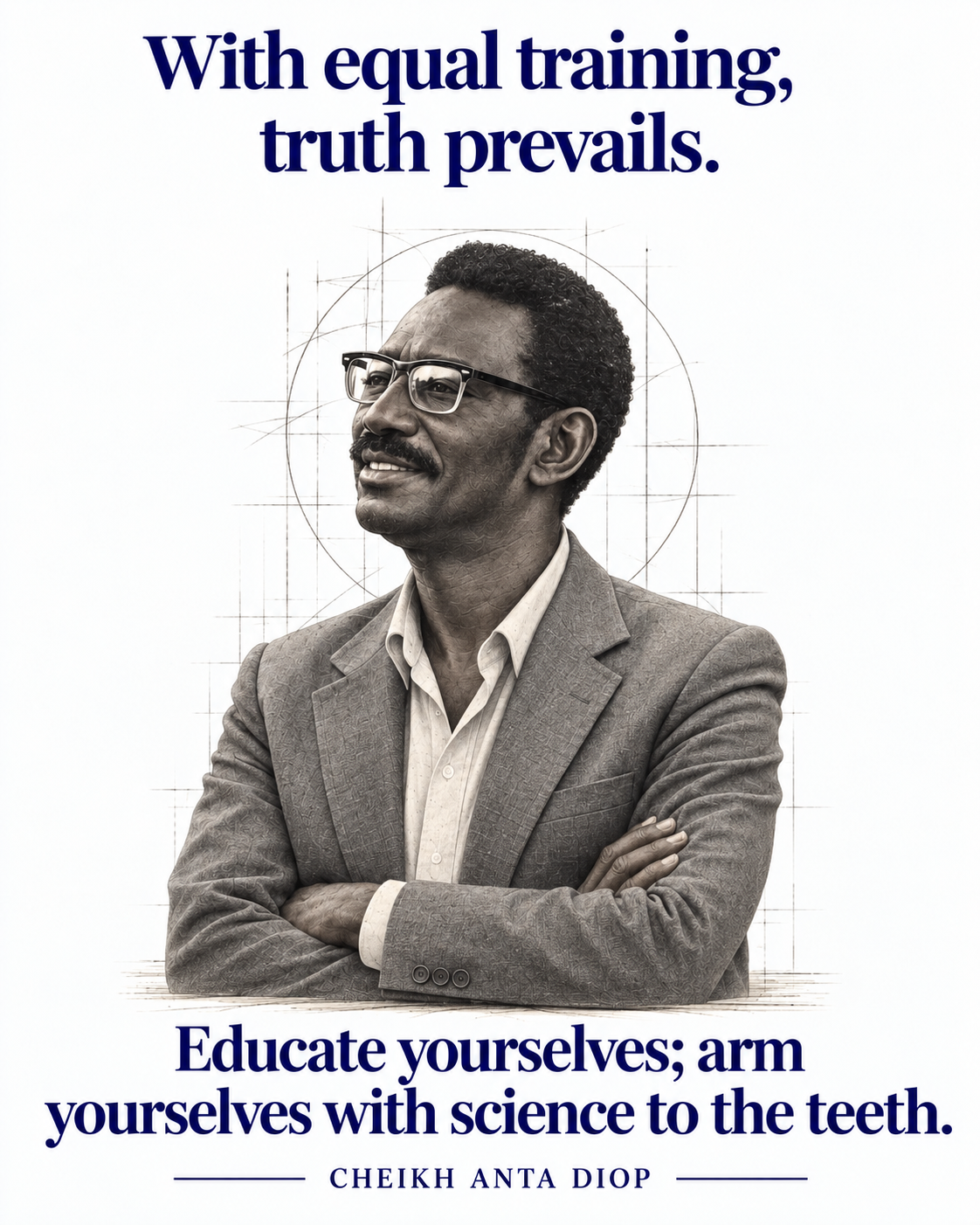
Editorial image: Cheikh Anta Diop — "With equal training, truth prevails. Educate yourselves; arm yourselves with science to the teeth."
In 1946, a young man from Thieytou, a village in the Diourbel region of Senegal, arrived in Paris to study. He could have chosen the path that was open and expected of him, which was law or letters, the disciplines that produced the clerks and interpreters of the colonial order. Cheikh Anta Diop chose physics and chemistry. He worked in the laboratory of Frédéric Joliot-Curie, a Nobel laureate, at a time when almost nobody at the Collège de France expected an African to be there. He studied nuclear physics, translated Einstein's theory of relativity into Wolof to prove that the language could carry it, and, in parallel, taught himself Egyptology, linguistics, and history well enough to write a doctoral thesis arguing that ancient Egypt had been an African civilisation.
The Sorbonne would not let him defend it. In 1951, no jury could be assembled; the thesis was politically impossible and, its opponents said, methodologically unsound. Diop did not change his conclusions. He changed his weapons. He went back to the laboratory, deepened his mastery of the sciences his critics respected, and returned nine years later with evidence that could not be dismissed on method. He defended in 1960 and won. When he went home to Dakar, he did not simply publish. He built a radiocarbon dating laboratory at the Institut Fondamental d'Afrique Noire, one of the first on the continent, so that African researchers could date their own past with their own instruments rather than wait for results from Paris. He trained the researchers who ran it and, late in his life, taught at the university in Dakar that now bears his name.
That is the biography behind a sentence that is usually printed on university walls as a piece of encouragement: "With equal training, truth prevails. Educate yourselves; arm yourselves with science to the teeth." Diop had lived it before he said it. He had been refused on the grounds of training, had acquired the training, and had prevailed. And then he had done the thing that turns a personal victory into a durable one: he put the capability into an institution that would outlast him.
Read that way, the sentence is not about individual study at all. It is a statement about capacity, about who holds it, and about what happens when it is accumulated, embedded in organisations and handed on. It is, in the vocabulary I have been using for some years, a statement about institutional capital. The correspondence between his life and the theory is close enough to set out in a table.
Cheikh Anta Diop's formation, read as institutional capital
| What Diop did | The capability it created | The Institutional Capital Theory reading |
|---|---|---|
| Chose physics and chemistry in Paris over law and letters | Command of the methods his adversaries respected, rather than the credentials the colonial system offered | Capability is acquired on the terms of the strongest field, not the most accessible one |
| Worked in Joliot-Curie's laboratory | Practice inside a high-performing scientific organisation, with its routines of evidence, review and verification | Individual competence forms fastest inside institutions that already hold accumulated capital |
| Translated relativity into Wolof | Proof that an African language could carry modern science | Knowledge becomes an institutional asset only when it can be expressed, taught and reproduced in the society's own systems |
| Had his thesis refused in 1951, returned with stronger method and defended in 1960 | The ability to hold a conclusion and improve the evidence rather than abandon either | Institutional memory and method are what allow an argument to survive a first defeat |
| Built the radiocarbon laboratory at IFAN in Dakar | Autonomous capacity to date African material with African instruments and staff | Ownership of an asset becomes institutional capital only when the capability to run it is held locally |
| Trained researchers and students at the laboratory and the university | A generation able to continue the work without him | Capital formation is the moment an institution can keep performing after its founders leave |
| Published in a language and form that his contemporaries could contest | A body of evidence exposed to challenge rather than protected from it | Science as institutional infrastructure: disagreement disciplined by reason is a public asset |
What can be taken away, and what cannot
Some of what a state depends on can be lost quickly. Fiscal space evaporates in a single bad year. A competitor takes market share in a season. Access to capital closes when a rating changes. Commodity revenues fall with a price. Roads and power plants wear out on a predictable schedule. All of this is real, and all of it can be lost by people who did nothing wrong.
Other things are much harder to take away once they have been accumulated in sufficient quantity. Knowledge is one. So are the scientific method, analytical habit, professional discipline, institutional memory, and the plain ability of a group of people to look at an unfamiliar problem, gather evidence about it and organise themselves to act. Nobody can seize these overnight. They can only be neglected until they fade.
Diop's injunction was about the second kind. His insistence on science was never about ornament or prestige. It belonged to a larger project, in which the ability of African societies to interpret their own history, generate their own knowledge and take part in the production of universal knowledge was itself a condition of autonomy. A people that could think for itself could not be told what to think. The radiocarbon laboratory in Dakar was the idea made concrete.
The institution exists; the asset may not
Development thinking has long treated education, research, data and expertise as inputs. Put more of them in, get more growth out. Institutional Capital Theory asks a different question: have these capabilities been turned into durable assets that an institution actually owns?
The distinction sounds abstract until you look at real cases. A country can have universities without a research system. It can have ministries without policy capability. It can have a laboratory with no scientific autonomy, a digital platform with no engineers to maintain it, a statistical office that publishes numbers it can no longer fully vouch for. It can have brilliant individuals whose knowledge leaves the public system on the day they retire, resign or emigrate. In each case, the formal institution is present, and the underlying asset is not.
So institutional capital is not the count of institutions a state possesses. It is the stock of productive capability embedded within them: knowledge, routines, systems, professional norms, data, organisational memory, ways of coordinating, trust, and the human competence that makes it all work. The question is not whether a state has a ministry of health. It is whether the Ministry of Health can do what a Ministry of Health is for.
What cannot be imported
Almost everything else can be. Countries import technology, license software, procure consultants, borrow policy models and buy infrastructure. Much of this is sensible. What cannot be permanently imported is the capability to govern what has been bought.
A government that acquires an advanced digital identity platform has acquired an asset. If its public servants cannot govern the architecture, maintain the code, audit the algorithms, manage the data and adapt the system as needs change, it has not acquired the capability that makes the asset productive. It has, in effect, bought a car without learning to drive, and it will be back at the dealer every time the road changes. The same holds for climate models, public financial management systems, hospital information systems, energy planning tools and, increasingly, artificial intelligence. Ownership and mastery are different things, and only the second one compounds.
From what a person knows to what an institution can do
Economists have understood human capital for half a century. Education and experience raise an individual's productivity; societies with more of it grow faster. The institutional view adds a question the human capital literature rarely asks: what happens to that competence when it enters an organisation?
Some organisations compound it. A well-trained economist joins a ministry where analysis is documented, challenged in review, stored where others can find it and built into procedure. When she leaves, the ministry keeps most of what she brought. Other organisations dissipate it. The same economist joins a ministry where knowledge lives in individual heads, decisions are made without records, incentives reward loyalty over competence, and nothing is written down that a successor could use. When she leaves, she takes the ministry's capability with her, and the ministry does not notice until the next crisis.
The human capital in the two cases is identical. The institutional capital is not. Institutional capital forms at the moment individual competence becomes collective: when a strong institution builds procedures around knowledge, keeps its memory, sets professional standards, runs data systems, codifies lessons, plans succession, allocates decision rights clearly, and learns from its own results. Above all, it is the moment when an institution can continue to perform after the people who built it have gone. That is what capital formation looks like in the public sector.
Decay you cannot see
Many states are stronger on paper than in practice. The ministries, agencies, strategies, laws and information systems all exist. The capability beneath them can be very shallow, and the difficulty is that its erosion leaves no visible trace.
A neglected bridge eventually cracks, and everyone can see it. A statistical office whose methodological skills have thinned out keeps publishing. A registry keeps issuing documents while its coverage quietly falls. A payment system keeps processing transactions while the software beneath it becomes something nobody in the country can safely modify. A regulator keeps its legal mandate while losing the engineers who could actually regulate the sector. The institution remains visible; the capital stock depreciates in silence.
This is why institutional decline is so often recognised late, when it has already reached the point of outcomes: slower decision-making, weaker implementation, policy reversals, growing dependence on external advisers for work the state once did itself, and, eventually, the loss of public trust. By then, the asset has been depreciating for years.
Science as infrastructure
This is also why "armed with science" deserves to be read beyond the laboratory. Science is a way of organising knowledge. It insists on evidence, measurement and verification; on method; on disagreement disciplined by reason; and on changing one's conclusions when the evidence changes. These are scientific virtues, but they are also the working virtues of a capable state.
Economic policy runs on credible data. Public health runs on surveillance. Climate adaptation runs on modelling. Agricultural transformation runs on research and extension. Energy systems run on engineering. Urban management runs on spatial data and integrated planning. Public finance runs on accounting, forecasting and auditing. Artificial intelligence runs on computing, data governance, technical expertise and institutional safeguards. In every one of these fields, science is part of the state's infrastructure as much as roads are. The societies that accumulate it can generate their own solutions. Those who do not must rent them.
The question artificial intelligence really poses
Diop's message may matter most in the age of artificial intelligence, and for a reason that runs against the popular story. AI dramatically widens access to knowledge. It does not widen the capacity to judge it. As these systems become more capable, the human and institutional ability to evaluate their output becomes more valuable, not less. Governments will need people who can tell when an answer is plausible but wrong, when a model has learned a bias, when the data behind it are incomplete, when automation should stop, and when human judgment must take over. They will need institutions that can define who decides, who is accountable, how outputs are validated and what standards apply.
The strategic divide, then, will not run between countries that have AI and countries that do not. It will run between countries that can absorb, govern and adapt these systems and countries that depend on systems they do not understand. That is an institutional capital divide, and it will be decided by training, not by procurement.
Accumulation as a development problem
Institutional Capital Theory rests on a simple proposition: institutions must accumulate productive assets over time. Some of these assets are physical. Most are not. Knowledge, data, professional competence, trust, institutional memory, administrative routines, technical standards, interoperable systems, and credible decision processes are all forms of capital. Their accumulation creates state capacity. Their depreciation weakens it. Their absence produces dependency.
Seen this way, investment in education and science cannot stop at graduation. The questions a government should be asking itself are harder. Can our universities produce research? Does that research reach policy? Can we retain our technical people? Do our institutions write down what their professionals learn? Can our systems be maintained after the vendor leaves? Do we produce our own data? Can our public organisations solve problems they have never seen before? Does expertise survive a change of government? Does knowledge compound here, or does it leak?
From exhortation to strategy
Read as a strategy rather than a slogan, "educate yourselves; arm yourselves with science to the teeth", says this. A society that accumulates knowledge becomes hard to subordinate intellectually. A state that accumulates technical capability becomes less dependent operationally. An institution that accumulates memory becomes a resilient organisation. A country that can generate its own evidence, maintain its own systems, train its own professionals, and improve its own institutions holds assets that are extremely difficult to take away.
That is the significance of institutional capital. It turns capability from a temporary condition into a durable stock, and it changes the measure of progress. The measure is not what a country has built. It is what the country has become able to do, and to keep doing when the people who first did it have gone.
Cheikh Anta Diop understood this before the vocabulary existed, and he acted on it in a laboratory in Dakar. Science, in his vision, was not a badge of modernity but an instrument of autonomy. Institutional Capital Theory applies that insight to today's public institutions, where the most consequential assets of a state rarely appear on any balance sheet. They live in its people, its systems and its habits of work, and once they are deeply embedded, reproduced and improved, they are among the most durable forms of national wealth there are.
With equal training, truth prevails. The task is not to take part in the knowledge economy. It is to build the institutional capital needed to shape it.
Further reading
This article draws on Institutional Capital Theory, developed at length in the book Institutional Capital Theory: An Economic Theory of Institutional Assets, State Capacity and Public Value, forthcoming from Institutional Public Policy Press in English and French. The book sets out the eight properties that qualify a capability as capital, the accumulation identity that governs how it forms and depreciates, the measurement framework that makes the stock observable independently of performance, and five regional cases, including the Rwanda-Burundi comparison and the loss of statistical capability in Argentina and Lebanon. Details are on the catalogue page.
The theory was first set out in a shorter form in the working paper Institutional Capital Theory: The Hidden Source of State Performance (July 2026), available in full in the earlier post The hidden source of state performance. Readers who want the argument of this article in its formal version will find the treatment of human formation and institutional memory in the chapters on formation, maintenance and depreciation, and the discussion of scientific and analytical capability as institutional infrastructure in the chapter on state capacity.