6 September 2026
The hidden source of state performance
Two countries pass the same laws, fund the same ministries, adopt the same policies and score within a point of each other on the governance indices. One collects its taxes, pays its teachers on time and borrows at a reasonable rate. The other does not. Anyone who has worked in public finance has met this pair. The usual explanations reach for leadership, political will or corruption. They are not wrong, but they explain by pointing at what cannot be measured. There is a more useful account that starts by looking below the waterline.
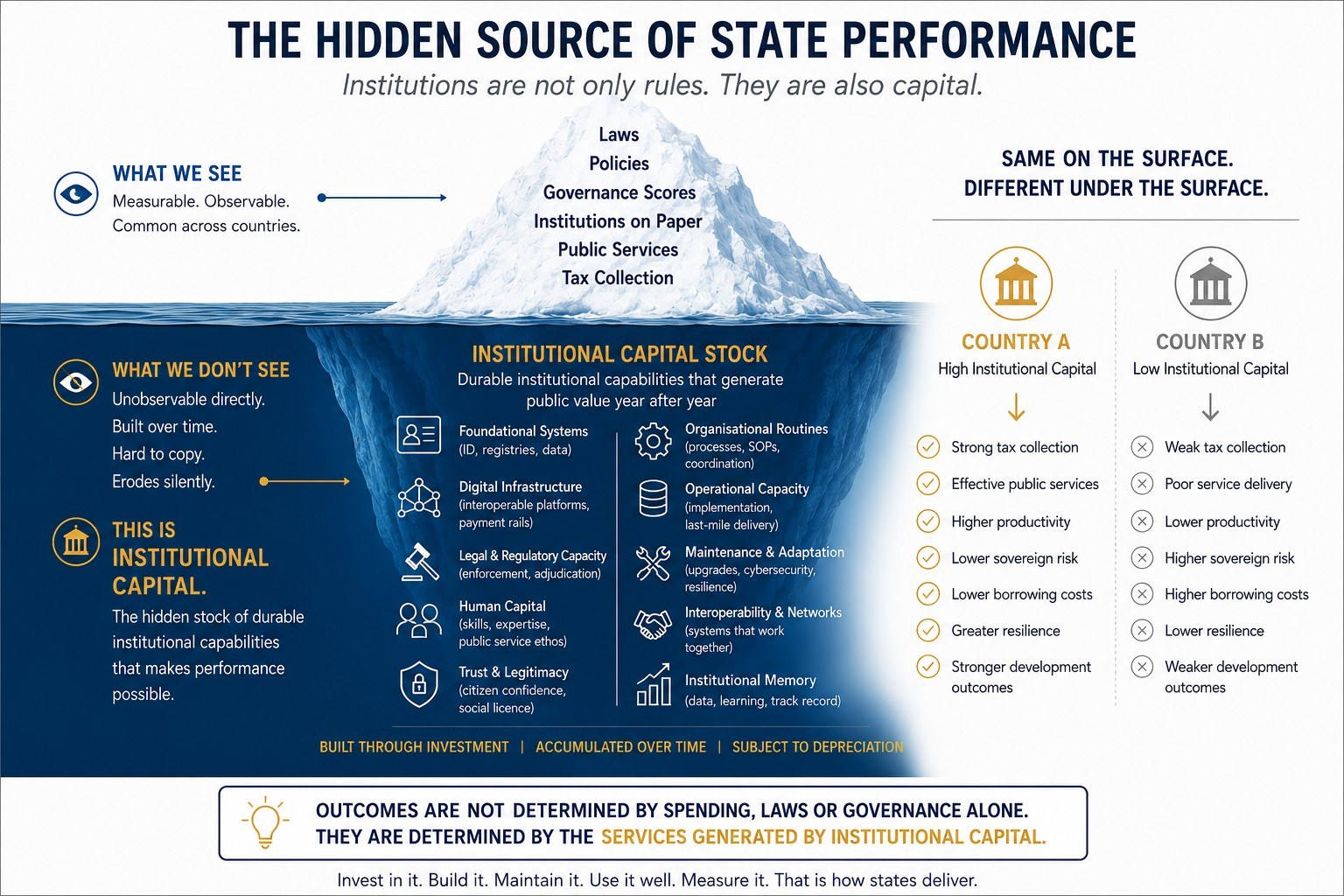
What we see, and what we do not
Above the surface sit the things that are observable and comparable across countries: laws, policies, governance scores, institutions on paper, public services, and tax collection. This is what gets measured, ranked and reformed.
Below the surface sits something else. A functioning civil registry. A treasury system that talks to the debt office. Payment rails that reach the last district. Statisticians who have produced the same series for twenty years. Judges who enforce contracts. Operating procedures that survive a change of minister. Cybersecurity that is maintained rather than announced. Data that is accurate, lawful and used. The institutional memory of an administration that has done a thing before and remembers how.
None of this is visible in a governance score. All of it is built over time, hard to copy, and prone to eroding without anyone noticing. This is institutional capital: the stock of durable capabilities that enables performance.
Why call it capital
The word is not a metaphor. These capabilities meet the ordinary economic tests for capital. They are created through investment. They persist beyond the year in which the money is spent. They raise future productive capacity. They accumulate, they can be maintained and upgraded, and they depreciate or become obsolete. They make other assets more productive: a road is worth more where procurement and maintenance function, a payment system is worth more where identity and tax data connect to it.
Once the capabilities are treated as a stock rather than a set of current attributes, a different set of questions follows. Not "how good is governance this year?" but "what productive institutional assets does this state hold, how were they built, how are they maintained, and how much of what is spent on institutions turns into something that lasts?"
Spending is not investment
That last question is the one governments most often get wrong. Institutional expenditure does not automatically create institutional capital. Training disconnected from roles, a registry that is not updated, a platform that cannot interoperate, a reform that ends when the donor financing ends: each produces activity without producing an asset. The share of spending that translates into durable operational capability varies widely across administrations, and it is that conversion rate, not the headline budget, that determines what the state can do five years later.
The same logic runs in reverse. A system can remain technically in place even as the service it delivers fades away. Data quality slips, staff leave, users route around procedures, trust drains. Nothing changes in the budget or the organisation chart. This is hidden depreciation, and it is the signature of institutional decay that expenditure-based and rules-based measures cannot detect until performance has already collapsed. By then, rebuilding costs far more than maintenance would have.
The central proposition
Put together, the argument gives a precise answer to the puzzle of the two countries. Outcomes are determined by the services an institutional capital stock delivers, and that stock is the accumulated history of investment that has been converted into durable assets, net of decay. So two states with identical spending, identical rules and identical governance ratings can diverge persistently, and the divergence traces to three quantities that are each observable on their own: how efficiently spending converts into assets, how fast those assets depreciate, and how productively the stock is deployed.
The proposition is deliberately narrower than "institutions matter", and it is falsifiable. If measures of institutional capital add no explanatory or predictive power beyond existing measures of governance, institutional quality and state capacity, the framework should be rejected. That is a test other researchers can run.
What follows for policy
If institutional capability is capital, it should be appraised like capital. Ministries of finance would separate recurrent administrative consumption from expenditure that builds durable assets and evaluate the latter over its lifetime, including maintenance. Development finance would ask whether a project leaves behind an interoperable, maintained, institutionally owned system or an isolated platform that becomes an orphan when the loan closes. Digital public infrastructure is the clearest case: identity, payments and data exchange become institutional capital only when embedded in law, organisations, routines, skills, security and public trust. A platform without those is a procurement, not an asset.
The short version fits on one line. Outcomes are not determined by spending, laws or governance alone. They are determined by the services that institutional capital generates. Invest in it, build it, maintain it, use it well, measure it. That is how states deliver.
The full argument, with the stock-and-flow model, the measurement architecture, and the empirical tests, is set out in Institutional Capital Theory, forthcoming from Institutional Public Policy Press.